Friday we took a trip to the town of Nuttallburg. Nuttallburg is situated along the New River in Fayette County. This was quite the adventure and like going back in time. I have since found out that my Grandparents on my mother's side resided in Nuttalburg for a few years living in a house located next to the Tipple. I'm currently working on finding out more about that. In the mean time here is a brief history with some pictures of our visit. (And to keep it dog related Teach and Bo (Randy's parent's Beagle) accompanied us on the hike.
 |
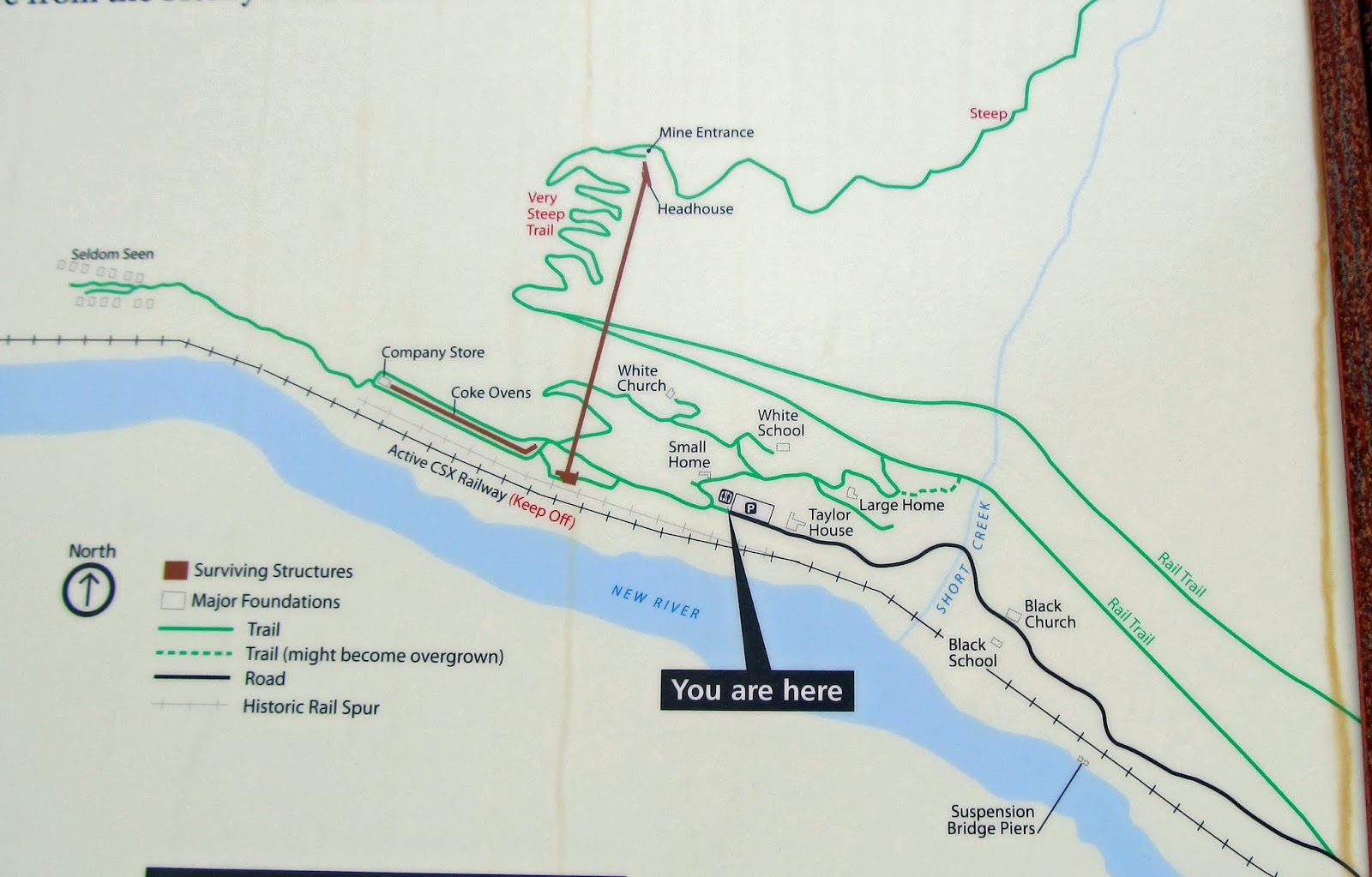
| Area Map of Nuttalburg |
As with most of the old coal towns in West Virginia, the mines in Nuttallburg began closing in the 1950s. As the mines closed (Nuttallburg officially closed in 1958) the miners left town in search of jobs. Nuttallburg became a ghost town and eventually was overtaken by an invasive plant called kudzu. A few years ago a project was started to preserve what was left of the town. According to the National Park Service the descendants of John Nuttall handed their property over to the park in 1998. In 2005, Nuttallburg was listed on the National Register of Historic Places. As the kudzu was killed and removed, workers found the remains and traces of the town of Nuttallburg.


John Nuttall, the namesake of the town, was born in England and after coming to America began opening coal mines. Nuttallburg was the home to several different coal companies over the years, but perhaps the most historic company was Fordson Coal and owned by a man named Henry Ford. Today in Nuttallburg you can see the remains of houses, the company store, buildings, coke ovens, churches, schools, roads, railroads, a suspension bridge, tipple, depot, and conveyor. The town had a church and school for the white residents and a separate church and school for the black residents.
The main feature in the town is the rehabilitated tipple and conveyor.
There is also a well preserved row of coke ovens which were used to turn coal into a fuel called coke.
The pillars from the suspension pedestrian bridge that crossed the New River are also still standing. The bridge was designed in 1899 by John Roebling, who also designed the Brooklyn Bridge, and connected Nuttallburg to South Nuttall. It was closed for safety issues around the time the mine closed.
 |
| As with a lot of WV some people are around that are rude and yell obscenities at you when you try to stop for a picture. So I took this pictures from this site: http://www.mywvhome.com/1900s/nuttallburg.html. It also gives a lot of history and pictures as well of the area. |
The remnants of a town called Seldom Seen can also be found about a half mile from Nuttallburg. This was a community of Nuttallburg miners who built a "suburb" or sorts.
 |
| This is heading back to Town from Seldom Seen |
Artifacts such as glass bottles, metal, and plastic can be found throughout the town. If you should ever visit the town please don't mess with the artifacts as they are a part of the town.
The Company Store in any Coal Town was normally the central part the area.